Java Full Stack Training Notes (2026) – Complete Learning Roadmap for Freshers and Java Developers
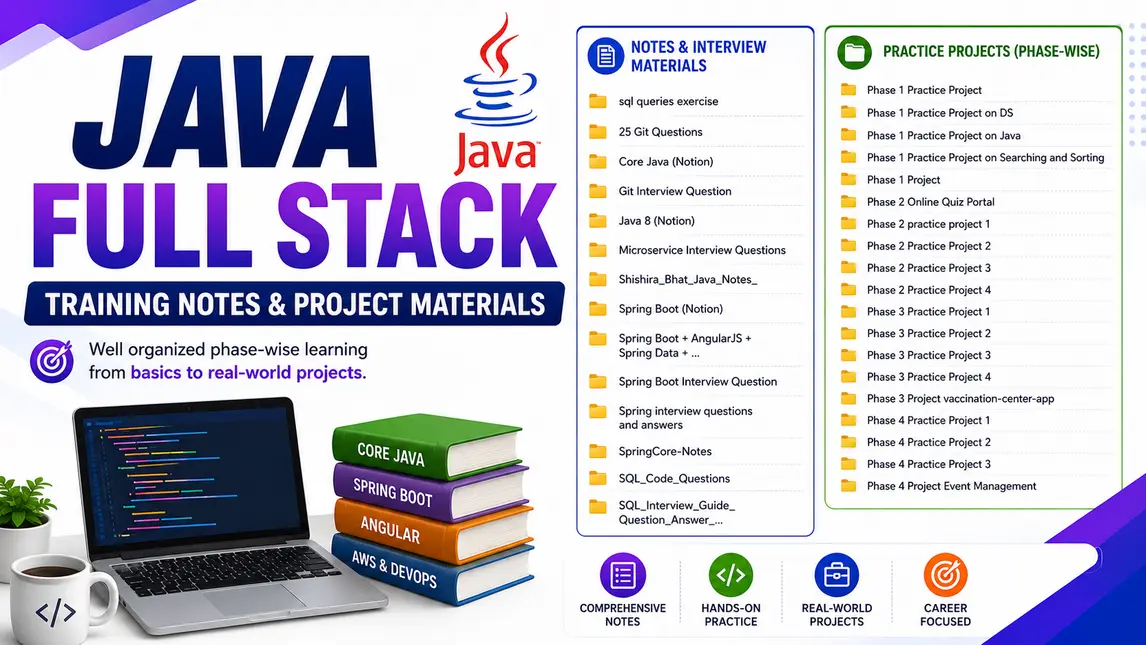
If you’re looking for the Java Full Stack Training Notes, you’ve come to the right place. These Java Full Stack Training Notes are designed for beginners, freshers, and Java developers with up to two years of experience who want a structured learning roadmap instead of scattered tutorials. During my learning journey, I collected notes, practice materials, interview preparation resources, and project files into a single organized roadmap. Rather than searching through dozens of websites, you can follow this phase-wise approach and build your Java Full Stack skills step by step.
Whether your goal is getting your first software job, switching companies, or preparing for Java interviews, these training materials can help you stay on track. The roadmap covers everything from programming fundamentals to building a real-world Full Stack application.
Why These Java Full Stack Training Notes Are Helpful
One of the biggest challenges for beginners is deciding what to learn first. Many students begin with Spring Boot or Angular without understanding Java fundamentals. Later, they struggle while building projects or attending technical interviews.
These Java Full Stack Training Notes solve that problem by following a structured learning sequence. Every phase builds upon the previous one, making the learning process easier and more practical. Instead of memorizing concepts, you’ll understand how enterprise applications are developed in the real world.
The notes are ideal for:
- Freshers
- Final-year students
- Java developers (0–2 years experience)
- Career switchers
- Interview preparation
- Self-paced learners
Java Full Stack Training Notes Learning Roadmap
The learning materials are divided into six practical phases. Each phase introduces new technologies after you’ve mastered the previous concepts, making the overall journey smoother and easier to follow.
Phase 1 – Java Programming Fundamentals
The first phase builds your programming foundation. Strong Java fundamentals make it easier to learn advanced frameworks like Spring Boot and Microservices later. This phase focuses on programming logic, object-oriented concepts, collections, algorithms, and problem-solving skills. Spending enough time here improves coding confidence and interview performance.
Phase 2 – Java Web Development
After learning Java basics, the next step is understanding how web applications work. This phase introduces enterprise Java technologies used for building dynamic applications, connecting databases, and processing user requests. It creates the bridge between standalone Java programs and modern backend development.
Phase 3 – Spring Boot & Enterprise Backend Development
Modern companies rely heavily on Spring Boot for backend development. This phase focuses on creating REST APIs, implementing authentication, developing scalable backend services, and understanding Microservices architecture. Learners also become familiar with testing practices and production-ready application development.
Phase 4 – Frontend Development
A Java Full Stack Developer also needs frontend development skills. This phase introduces responsive web design, JavaScript, Bootstrap, and Angular for building interactive web applications. By combining frontend technologies with backend APIs, learners gain complete Full Stack development experience.
Phase 5 – Testing, Cloud & DevOps
Software development doesn’t stop after writing code. Modern applications require testing, deployment, monitoring, and automation. This phase introduces cloud technologies, containerization, continuous integration, continuous deployment, and testing tools commonly used in enterprise environments.
Phase 6 – Full Stack m-Aadhaar Application
The final phase combines everything learned throughout the roadmap into a complete Full Stack project. The m-Aadhaar application demonstrates how backend services, frontend interfaces, databases, authentication, deployment, and DevOps practices work together in a real-world application.
Completing a project like this significantly improves practical knowledge while strengthening your resume and interview portfolio.
Benefits of Using These Java Full Stack Training Notes
Following a structured roadmap offers several advantages over learning random technologies individually.
Some major benefits include:
- Structured phase-wise learning
- Strong Java fundamentals
- Better understanding of enterprise development
- Improved coding skills
- Better interview preparation
- Hands-on project experience
- Industry-relevant technologies
- Easier revision before interviews
- Better confidence during technical discussions
- Practical Full Stack development experience
Who Should Download These Java Full Stack Training Notes?
These materials are suitable for:
- Java Beginners
- B.Tech Students
- MCA Students
- Fresh Graduates
- Java Developers
- Software Engineers with up to 2 years of experience
- Interview Preparation Candidates
- Working Professionals upgrading their skills
Google Drive Download:
Note: If the Google Drive folder is updated with new notes, interview questions, or project resources, the latest files will be available through the same link, so you won’t need to download everything again.
Why a Phase-wise Roadmap Matters
Learning technologies randomly often leads to confusion because advanced frameworks assume you already understand programming fundamentals. A phase-wise roadmap helps you learn concepts in the correct order, making every new technology easier to understand.
By following this roadmap, you’ll spend less time searching for resources and more time building practical skills that employers value.
Final Thoughts
These Java Full Stack Training Notes are intended to simplify the learning journey for beginners and early-career developers. Instead of following multiple courses simultaneously, you can progress through a single organized roadmap that covers programming fundamentals, backend development, frontend technologies, testing, cloud platforms, DevOps tools, and a complete Full Stack project.
Consistent practice, project building, and regular revision are the keys to becoming a successful Java Full Stack Developer. Use these notes as your primary learning guide, continue solving coding problems, and keep improving your practical development skills.
Conclusion
The Java Full Stack Training Notes provide a structured and practical roadmap for anyone starting a career in Java development. By learning each phase in sequence and applying your knowledge through projects, you’ll develop the technical skills required for interviews and real-world software development. Whether you’re a fresher or a developer with up to two years of experience, this roadmap can serve as a valuable companion throughout your learning journey.
Frequently Asked Questions
1. Are these Java Full Stack Training Notes suitable for beginners?
Yes. They are designed specifically for beginners and freshers starting from scratch.
2. Do these notes include project materials?
Yes. The roadmap includes a Full Stack m-Aadhaar project.
3. Can experienced developers use these notes?
Yes. Developers with up to two years of experience can use them for revision and interview preparation.
4. Is this roadmap enough for Java Full Stack interview preparation?
It covers the major technologies commonly expected for entry-level and early-career Java Full Stack roles.
5. Are these Java Full Stack Training Notes free?
Yes. These notes are shared to help learners build strong Java Full Stack development skills.